
Continuous Technical Education
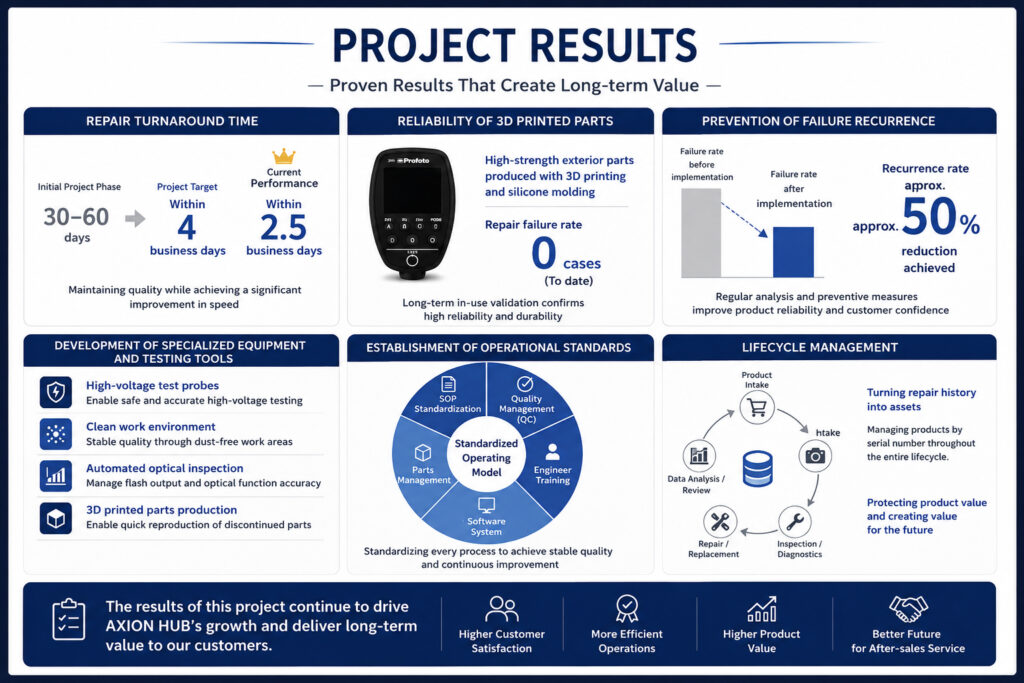
Project Results
Building More Than a Service Center
The Profoto project was never intended to be only a repair operation.
From the beginning, the objective was to establish a stable after-sales service capable of supporting product quality, customer satisfaction and long-term business operations.
Over time, the project evolved into a complete operational system covering repair workflows, quality management, logistics coordination, engineer training and continuous operational improvement.
Instead of relying on individual experience, standardized processes enabled the service center to deliver consistent service while continuing to adapt to new products and changing operational requirements.
A Stable Operational Foundation
The project established a service operation that could continue improving beyond its initial implementation.
Repair procedures became standardized.
Quality inspection processes became more consistent.
Technical knowledge was continuously documented and shared.
Operational data was used to identify recurring issues and improve future repair activities.
These improvements allowed the organization to maintain stable service quality while supporting increasing operational complexity.
Supporting Product Quality Beyond Repairs
The role of the service center extended beyond repairing defective products.
Repair records, recurring failure analysis and engineering feedback provided valuable information for improving products and manufacturing processes.
Instead of treating each repair as an isolated task, operational data became part of a continuous improvement cycle involving quality management, engineering and customer support.
This allowed after-sales operations to contribute not only to customer service but also to long-term product quality.
Building Capabilities for Future Projects
One of the most valuable outcomes of the Profoto project was the operational experience it created.
The systems, workflows and management methods developed during the project later became the foundation for supporting other brands and service operations.
Rather than creating a process for a single customer, AXION HUB developed operational capabilities that could be adapted to different products, industries and business models.
This experience also contributed directly to the development of the AXION HUB Operations Standard (AHOS).
The Outcome
The success of the Profoto project was measured not only by repaired products or completed service requests.
More importantly, it demonstrated that reliable after-sales operations can be built through standardized processes, continuous learning and systematic operational management.
The project became an important milestone in AXION HUB’s journey from operating a single service center to developing a broader operational framework for future after-sales services.
From a Single Project to AHOS